Industrial Epoxy Coatings
in Houma
Heavy-duty epoxy and urethane cement systems for oilfield fabrication shops, marine service yards, seafood processing floors, and warehouse build-outs across Terrebonne Parish. The crew that handles Louisiana’s largest and most complex projects.
Industrial Flooring for Houma’s Oilfield and Marine Economy
Houma is an industrial town first. The fabrication shops, valve and pump repair facilities, pipe yards, and marine service yards that line the Houma Navigation Canal keep the Gulf’s offshore energy sector running, and the floors in those buildings take a beating that ordinary commercial epoxy is not built for. Hydrocarbon and hydraulic-fluid spills, forklift and pallet-jack traffic, dropped tooling, and standing wash-down water all attack a coating at once. On top of that, the same coastal humidity that plagues residential slabs is present in these buildings, so moisture in the substrate has to be managed before anything goes down. We specify industrial-grade systems matched to the actual load, chemical exposure, and thermal conditions each facility sees.
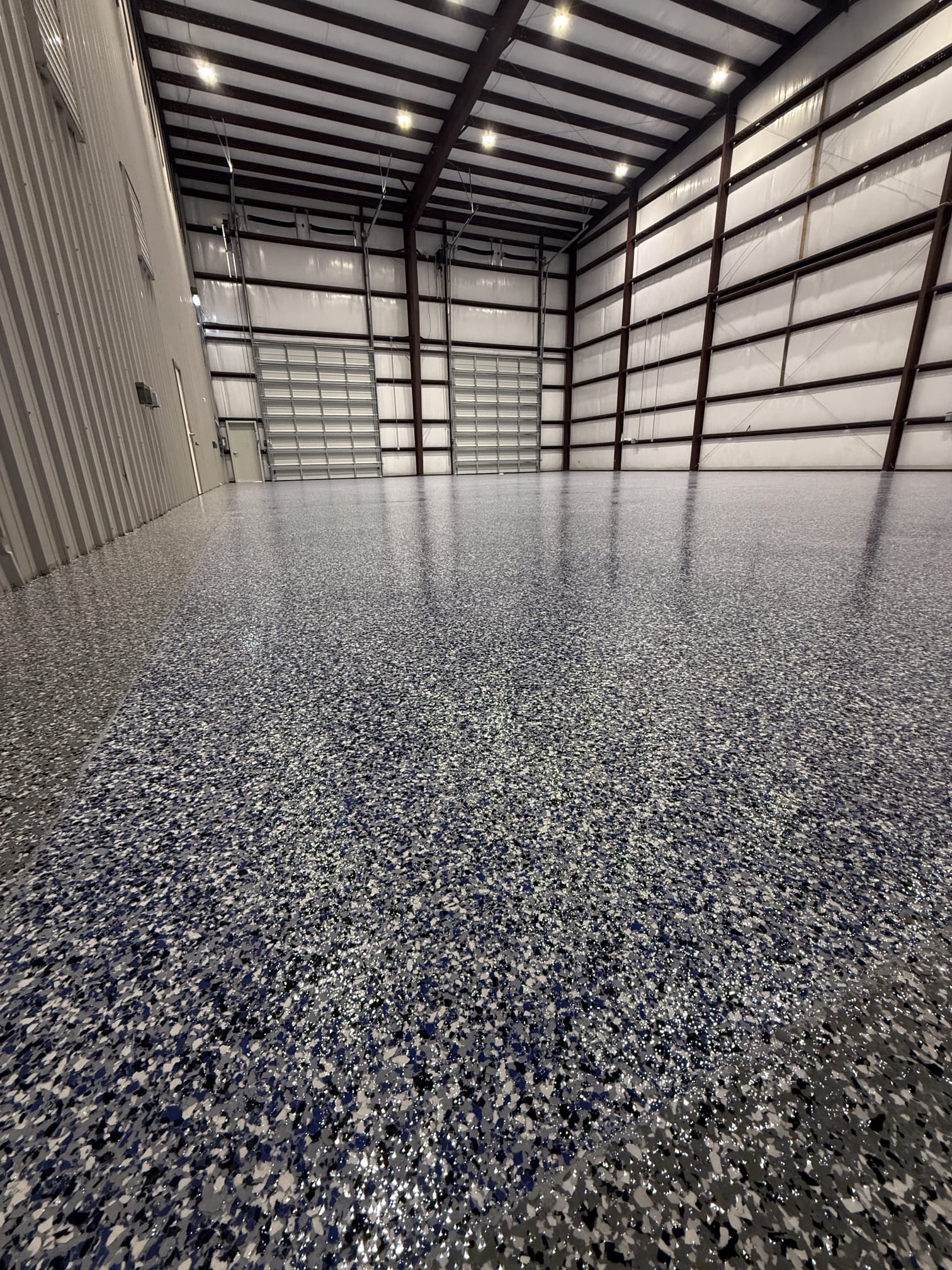
We completed a 135,000 square foot industrial installation for MMR, a data center equipment manufacturer valued at over a billion dollars. That project demanded consistent specification, consistent surface preparation, and consistent application across a massive footprint. We bring that same discipline to a Houma machine shop or a seafood processing plant, regardless of scale.
Industrial Systems We Apply in Houma Facilities
- 100% solids epoxy. The baseline for heavy industrial floors, applied at 20 to 40 mils dry film thickness. It resists hydrocarbons and shop chemicals, carries forklift and rack loads, and leaves a seamless surface that cannot absorb spills or harbor bacteria.
- Urethane cement. Built for thermal shock, aggressive chemical exposure, and the constantly wet floors in seafood and shrimp processing plants around Houma. Urethane cement holds from below freezing to over 250 degrees Fahrenheit without delaminating. See our urethane cement page.
- Anti-slip epoxy systems. For loading docks, wash-down bays, and pedestrian routes where wet marine and processing floors are a genuine safety hazard. See our anti-slip coatings page.
- Secondary containment coatings. For chemical storage areas, fuel and lube rooms, and tank containment curbing common in oilfield service yards. These systems block penetration through the slab into the substrate below.
Working Around Production in Houma
Industrial floor projects in Houma rarely happen on an empty building. Fabrication shops run tight delivery schedules, marine yards move vessels in and out on the tide, and processing plants cannot let product sit. We coordinate directly with facility managers and plant engineers, phase installations so parts of the floor stay in service, and work shift schedules when that keeps the operation moving. Hurricane season adds another layer, and we plan cure windows around forecast weather so a fresh coat is not caught mid-cure by a storm. See our industrial coatings page and finished work in our project gallery. Call (225) 456-9224 or contact us.
Why Houma Facilities Bring Us In
The industrial buildings around Houma were built for function, and their floors have usually been through a lot before we ever see them. Old coatings that failed and were painted over, saw-cut joints that were never sealed, spalled areas around drains, and slabs that have absorbed years of oil and hydraulic fluid are the normal starting condition, not the exception. A crew that only knows how to roll a coating onto clean concrete cannot deliver a floor that lasts in that environment. We diagnose what the slab has been through, remove failed material down to sound concrete, address contamination that would otherwise block adhesion, and rebuild the floor with the right system. That diagnostic work is the difference between a coating that holds for a decade and one that lifts inside a year.
Scale is the other reason Houma facility managers call us. A single machine shop bay is a small job for a crew that ran 135,000 square feet for MMR without a break in specification or quality. When a fabrication shop, a marine yard, or a processing plant needs consistent results across a large footprint, phased around a live operation, that is exactly the kind of work Signature was built to execute. Connor is on every quote and every walkthrough, and there is no account-manager layer between you and the people preparing and pouring the floor. Reach him at (225) 456-9224 or through our contact page, and browse completed commercial floors in our gallery.
Matching the System to the Chemical Exposure
The single most common mistake in industrial flooring is treating every shop the same. A pipe yard, a valve repair bench, a fuel and lube room, and a seafood processing line all attack a floor differently, and a coating that is right for one can be wrong for the next. That is why the first step on any Houma industrial job is understanding exactly what the floor will see. What chemicals are present, and at what concentration and temperature. Where the point loads land and how heavy they are. Whether the floor is dry, occasionally wet, or wet constantly. Whether thermal shock from hot wash-down or cold storage is a factor. Only once those questions are answered can the right system, film thickness, and chemical resistance profile be specified with any confidence.
In practice that means a Houma fabrication shop bay might get a 100% solids epoxy at heavy film thickness for its mechanical durability and hydrocarbon resistance, while the wash-down bay next door gets urethane cement for its thermal and moisture tolerance, and the chemical storage room gets a containment-grade system that blocks penetration into the slab. Getting those transitions right, and specifying the correct coving and drainage detailing where wet and dry areas meet, is the difference between a floor that functions as a system and a patchwork that fails at the seams. This is the kind of specification work a crew that only knows one product cannot do. We carry twenty-one floor systems and pick the right one for each zone of your facility. Call (225) 456-9224 or reach us through our contact page to have your floor assessed.
Coastal Moisture and the Houma Slab
Nothing decides the life of an industrial floor along the Houma Navigation Canal more than what is happening inside the slab. The buildings that line the canal sit low, close to the water table, and the Gulf humidity that never fully lifts keeps the concrete carrying a vapor load that a dry inland slab simply does not have. That moisture wants to move up through the slab, and when it reaches the underside of a coating that was not built to breathe or was applied without mitigation, it lifts the coating right off the concrete. Blistering, delamination, and adhesion failure in Houma industrial buildings almost always trace back to moisture that was never measured, not to a bad product. We test the slab with calcium chloride and relative humidity probes before we specify anything, and where the reading calls for it we lay a vapor-mitigation primer that ties the coating to the concrete and gives the moisture a controlled path. On a fabrication floor or a processing slab that runs a live operation, that primer is not an upsell, it is the reason the floor is still down in ten years.
Hurricane season stacks a second moisture problem on top of the first. A shop that took water during a storm, or a slab that sat wet while a building dried out, holds that moisture for weeks, and coating over it before it releases guarantees failure. When we phase a Houma industrial project through storm season, we read the slab on the day we coat, not on the day we quoted, and we hold the schedule when the concrete is not ready. That patience is part of what facility managers along the bayou are actually paying for. Call (225) 456-9224 or reach us through our contact page.
Industrial Coatings in Houma FAQ
What industrial floor coating holds up in a Houma oilfield shop?
For most oilfield fabrication and repair shops we specify 100% solids epoxy at heavy film thickness, which resists hydraulic fluid, diesel, and shop chemicals while carrying forklift and rack loads. Where thermal shock or constant wash-down is a factor we move to urethane cement. We match the system to the actual exposure after walking the floor. Call (225) 456-9224 to discuss your facility.
Can you coat a floor in a working Houma marine service yard without shutting it down?
Yes. We phase installations so sections of the yard or shop stay operational while other sections are prepped and coated. This takes planning at the front end, and we build the phasing into the written scope so your operation keeps moving. Contact us through our contact page to map it out.
What flooring works for a Houma seafood processing plant?
Urethane cement. Shrimp and seafood processing floors are wet constantly, hit with hot wash-down water, and exposed to salt and cleaning chemicals. Urethane cement handles the thermal swing and the moisture without delaminating, and it can be finished slip-rated for worker safety. Standard epoxy is not appropriate for that environment.
How does Houma humidity affect an industrial coating install?
Coastal humidity means the concrete substrate almost always carries meaningful moisture. Before we coat, we test the slab and, when needed, specify a moisture-tolerant or vapor-mitigation primer. Skipping that step is the most common reason industrial floors fail here, and we do not skip it.
Do you work with general contractors on new Houma industrial construction?
Yes. We work directly with GCs on new industrial and commercial construction across Terrebonne Parish and statewide, providing written scope, schedule, and material specifications. Contact us at our contact page or call (225) 456-9224.
Industrial Coatings in Houma
Heavy-duty epoxy and urethane cement for Houma’s oilfield and marine sector. Complex projects handled.
Call (225) 456-9224 Free Price