Metallic Epoxy Flooring
in Inniswold
Pearl and mica pigment hand-poured over a ground slab, for living rooms, game rooms and the shops some owners here finish as nicely as the house. Connor or a senior installer reads the moisture first, lays samples down under your own light, and prices the job from what the concrete actually shows. The senior crew pours every metallic we sell.
A Finished Room or a Paneled Shop
Inniswold is one of the places where we get asked for the high-end metallic work, and the requests tend to split two ways. Some owners want the floor in a finished room: a den, a living area, an entry that opens to the yard through French doors. Others want it in a garage or shop they have trimmed out like a room, pine on the walls and a TV mounted where the pegboard used to hang. The pour is the same craft in both places. What changes is what the floor has to put up with and how light lands on it.
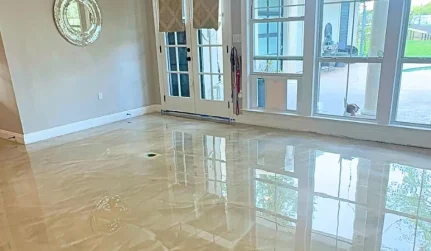
A finished room has tall windows, lamps and furniture legs. Daylight rakes low across the floor late in the afternoon and picks out every ridge in the pour, so flatness matters there more than anywhere. A shop has an overhead door, rolling tool chests and the occasional dropped wrench. That room wants a harder wear coat and a pattern busy enough to swallow a scuff. We plan the two differently from the first visit, even when the pigment is identical.

A shop floor becomes a show floor once the walls get paneled and a TV goes up. Dark bases with silver movement read rich in that kind of space and forgive tire dust far better than a pale pour does. It still gets the heavier clear on top, because a shop is still a shop.
Old Concrete Shows Through Clear Resin
Much of Inniswold was built across five decades on lots that have had time to mature, and plenty of the concrete under these houses went down before 1990. Slabs from that era often have no vapor barrier beneath them. Even this far inland, that means a slab can read damp, and moisture rising under a metallic is the quickest way to lose one. It shows up as haze, as bubbles trapped in the art, or as coating that lets go in a sheet.
So the moisture test opens every quote here, and the number picks the primer. A low reading gets the standard primer. A higher reading gets a moisture-tolerant primer under everything else. If the slab runs so wet that no primer will hold, you hear that at the walk, before any deposit changes hands.
Metallic is less forgiving than chip about everything else, too. A flake floor buries a patched crack under thousands of colored chips. A metallic is a translucent pour, and an old repair line, a ridge of tile adhesive or a shallow low spot will telegraph straight up through the pattern. On older slabs we grind past every layer of paint and mastic to bare concrete, chase the cracks out and fill them, and flatten the trouble areas before any pigment leaves the bucket. That extra grinding is in your price before you sign.
Approving the Color Before Anything Cures
Our metallic consults run in a fixed order: samples first, a mockup second, the pour third. The samples come to the house, and we lay them on your floor in the room the floor is going into, because pearl and mica change character with the light around them. A cream blend that looks warm under a showroom bulb can turn cool beside north-facing windows. A charcoal and silver mix that seems flat in daylight can come alive under a TV wall at night.
On larger pours we mock up a section before committing the whole room, so you see how the pigment moves at full size. Color strategy beats color count. One dominant tone with a single accent usually reads richer than four pigments competing, and the base color underneath sets the undertone of everything above it. Custom blends matched to brick, cabinetry or a stone fireplace are on the table when the room asks for one.
Two installers holding the same materials will never pour the same floor, which is why the senior crew handles ours. Blown air, a comb or a solvent drop pushes the live resin into waves, drifts or cells, and the person holding the tool decides where it settles. The floor that cures is the one you signed off on.
In a living room, glare is the thing to plan around. French doors and tall windows throw long reflections across a gloss pour. A satin wear coat calms those reflections and keeps the pearl movement readable from the couch. Both sheens go on the sample board so you can decide standing at your own windows.
The Wear Coat Protects the Art
The metallic layer is the art, and it is soft compared to what goes over it. Every metallic we install gets a clear wear coat, polyaspartic or urethane depending on the room, and that coat takes the foot traffic, the chair legs, the sunlight and, in a shop, the hot tires. Leaving it off saves money for about a year. After that the busy paths scratch gray and the pattern dulls right where people walk most.
Sheen is your choice. Gloss gives the deepest look and the strongest reflections. Satin is quieter, hides fine scratches better and suits rooms with a lot of glass. Rooms that take direct sun through open doors or big windows get the aliphatic topcoat upgrade, which holds the color depth against the amber shift that standard clears eventually show. It sits on its own line, priced where you can see it.
Day to day, the care is plain: a dust mop, a neutral cleaner and mats at the exterior doors. When a scratch does show up years in, the clear gets buffed and recoated without anyone touching the art underneath.
Where the Floor Falls in a Renovation
Most residential metallics take three to four days from first grind to the finish walk, and that count includes a controlled-cure day when the room stays closed and nobody walks on it. Put the floor in the middle of the project. Painters and drywall finishers go first, since overspray and joint mud on a fresh pour mean a recoat. Furniture, rugs and cabinets come in after the cure.
We coordinate with painters and cabinet installers on Inniswold jobs routinely, and an empty room grinds faster, pours cleaner and costs less than one we have to work around. If your contractor already keeps a calendar, we slot into the window between the last coat of wall paint and move-in day. Connor stays reachable by phone through every stage. Look at finished floors in our gallery, read how the system is built on our metallic epoxy floors page, or describe the room through the contact page.
Other floors we install in Inniswold
- Metallic epoxy, the hand-poured system on this page.
- Polyaspartic coatings for older garages carrying several coats of paint.
- Pickleball court coatings for backyard and shared-lot courts.
- Retail and showroom flooring for shops near the parish line.
- Restaurant flooring, one system for the kitchen and another for the dining room.
- Every system we offer locally, with common questions, sits on our Inniswold service area page.
Questions Owners Ask Before a Metallic Pour
Can a metallic go over the old tile adhesive in our den?
Not directly. Mastic and old adhesive get ground off down to clean concrete first, because anything left under a translucent pour shows through it. That grind takes longer than a bare slab does, and the extra hours appear in the written price before you agree to anything.
Our house was built in the 1970s. Does the slab need anything special?
Probably a moisture-tolerant primer. Slabs poured before 1990 often went down without a vapor barrier, so we test before we price. The reading takes minutes at the walk and decides which primer goes under the metallic. If the number says wait, you hear it that day.
Will the finished floor look like the sample?
Close, and the mockup closes the gap. Samples are small, and a metallic moves differently across a whole room. On larger pours we mock up a section at full size so you approve the movement and the color in your own light before the rest of the room gets poured.
Gloss or satin for a room with lots of windows?
Satin, usually. Gloss reflects every window and lamp. Satin keeps the pearl movement visible while calming the glare, and it hides fine scratches better over time. We bring both sheens on the sample board so you can compare them in place.
How long until the furniture can come back in?
Plan on three to four days for most residential metallics, including a controlled-cure day when the room stays shut. Foot traffic returns before furniture does. The schedule lists each day, and felt pads under chair and table legs keep the wear coat looking new for years.
Does a shop floor need a different build than a living room?
Same pour, heavier protection. A paneled shop sees rolling chests, dropped tools and hot tires, so we usually spec a tougher wear coat and steer toward darker bases with silver movement that hide dust. A living room gets more of our attention on flatness and glare.
Fifteen Minutes From Our Shop
Inniswold sits in the southeast part of East Baton Rouge Parish, about fifteen minutes from our Baton Rouge shop. That short drive is why sample visits here happen the same week you call. The crew that prices your metallic is the crew that pours it. Reach us through the contact page or at (225) 456-9224.
Put the Samples on Your Own Floor
A moisture reading, pigment set down in the light you live with, and a written number that holds. Then the senior crew pours the room you approved.
Talk to Connor Price the Pour