Garage Epoxy Coatings
in Lafayette
Flake, solid-color, and polyaspartic garage floors for Acadiana homes and shops. Built around what a Lafayette garage actually holds: a work truck, a rolling toolbox, and everything that comes home off a hitch. Installed by the same crew that runs Louisiana’s largest commercial epoxy jobs.
The Slab Under a Lafayette Garage
Lafayette sits up on the Prairie terrace, which gives it a real advantage over the bayou parishes south of here. The ground drains better, the water table generally sits lower, and slabs in this city are not fighting the same standing groundwater that a slab in Terrebonne or Lafourche deals with year round. That is a genuine head start. It is also the reason a lot of coating crews working Lafayette skip the moisture test entirely, and it is why we still run one on every single job.
Better drained does not mean dry. Acadiana air carries moisture nine months of the year, and concrete moves vapor regardless. What determines whether a coating holds is the vapor coming up through the slab the day we coat it, and that depends on the vapor barrier under the pour, how the lot drains, and what the slab has been sitting through. None of that shows up by looking. It shows up on a meter. The vapor test rules here the same as it does anywhere in south Louisiana, and skipping it because Lafayette drains well is exactly how a floor ends up bubbling in year two.
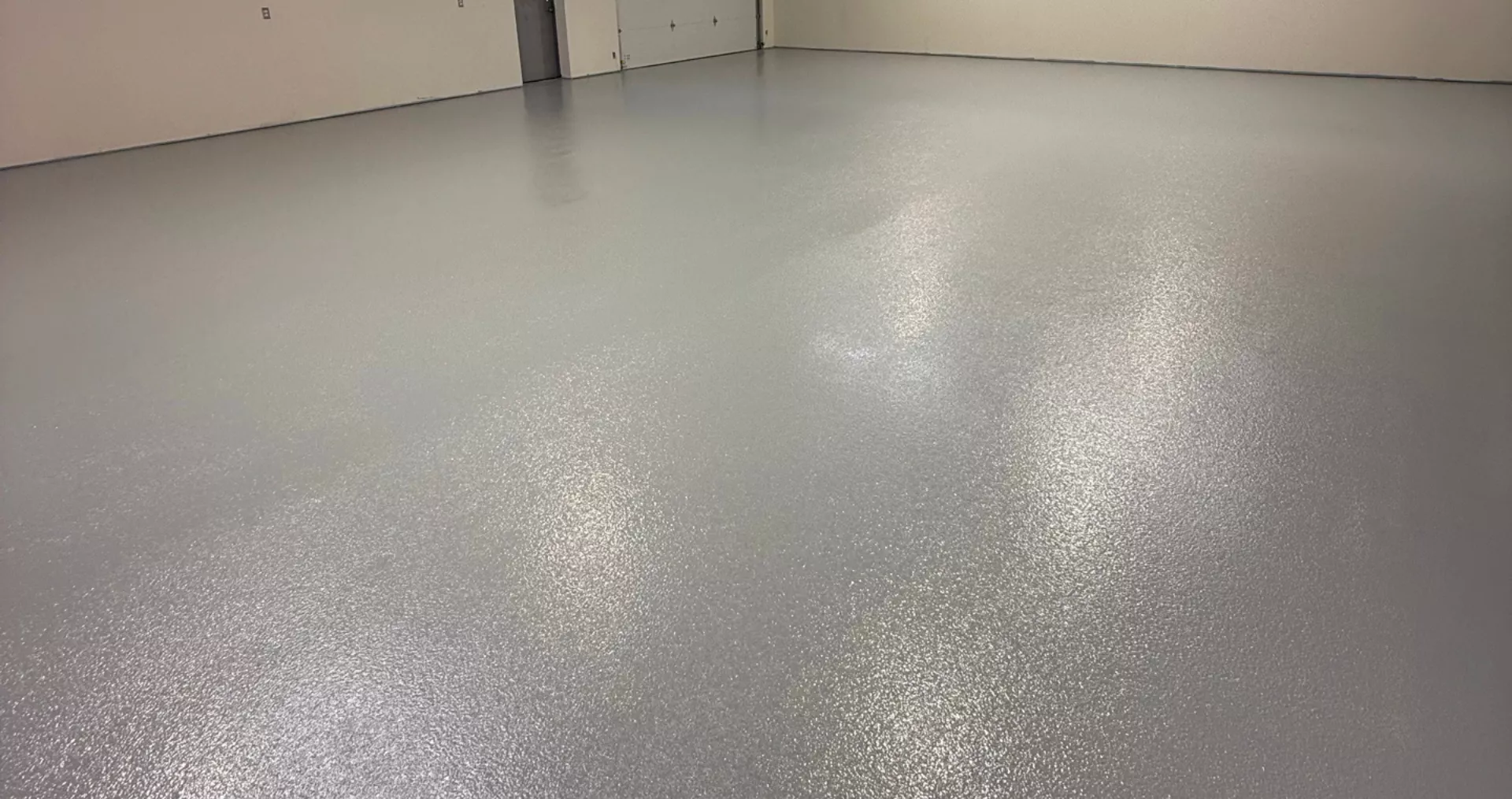
The other Lafayette variable is the age spread. A garage in one of the newer builds out toward Youngsville or in the neighborhoods off Camellia was poured recently, over a modern vapor barrier, on a slab that is still curing out and reads high on a meter for the first several months. An older slab near the university or in the established neighborhoods around Girard Park may have gone down before anybody was fussy about under-slab plastic, and it has forty or fifty years of parked vehicles, oil, and hot-tire pickup soaked into it. Those two floors need different work, and quoting them the same way is a shortcut we do not take.
Systems We Put Down in Lafayette Garages
- Flake epoxy. The one most Lafayette homeowners land on. Vinyl chips broadcast into the wet base give you a speckled, textured surface that hides brake dust, red dirt off a job site, and everything a work truck drags in. It grips when it is wet and it does not telegraph every mark. More detail on our flake epoxy page and on flake epoxy in Lafayette.
- Solid-color epoxy. One clean color edge to edge. It reads bright, it sweeps easy, and it is the usual pick for service bays, small shops, and homeowners who want the floor to disappear rather than be a feature.
- Polyaspartic coatings. A fast-curing aliphatic polyurea topcoat that will not yellow under the light coming through an open garage door, cures harder than epoxy, and gets your truck back inside sooner. In Lafayette we usually run it as the topcoat over an epoxy base, which is the combination that holds best in this humidity. See our polyaspartic coatings page.
How We Prep and Pour a Garage Here
Prep is diamond grinding or shot blasting the concrete to an ICRI CSP 3 through CSP 5 profile, which is the mechanical key the coating locks into. Cracks and control joints get chased open and filled with rigid epoxy. Moisture mitigation goes in where the meter calls for it. Then primer, base coat, the decorative layer if you are getting one, and topcoat. We do not acid etch as the only prep on a floor we warranty. Etching leaves residue behind and never builds enough profile to hold in Acadiana conditions.
Grinding is where most cheap Lafayette garage jobs get shorted. A light pass with a hand grinder knocks the sheen off and looks like prep, but it leaves you a CSP 1 with nothing for the coating to grab. We run a planetary grinder with diamond segments matched to the hardness of the slab in front of us and pull the dust through a HEPA shroud so the concrete is clean when primer hits it. A 1970s slab near the university takes a different segment than a slab poured last spring in a Youngsville subdivision, and we set the machine accordingly.
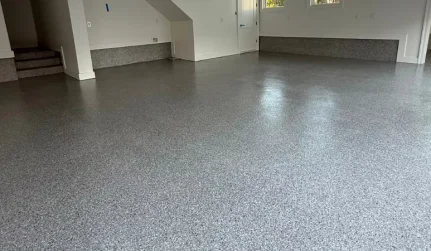
On a full-flake garage we broadcast chip to refusal, meaning we keep throwing flake into the wet base until the floor will not take any more. After cure we scrape the loose chip, vacuum it off, and lay clear polyaspartic over the top so the texture is locked down and the surface sweeps clean. A partial broadcast looks fine the day we leave and shows every wear path two years on. Doing it to refusal costs more in material and labor, and it is the difference between a professional floor and a floor that reads like a kit off a shelf.
Timing matters more here than people expect. Polyaspartic often walks the same evening and takes vehicles in about a day, which is worth a lot when an August afternoon can drop two inches of rain and you need those doors shut. Straight epoxy runs longer, and on a high dew-point day we watch the surface closely, because moisture landing on uncured epoxy leaves an amine blush, a greasy haze that has to be scrubbed before the next coat will bond to it. We schedule around the weather instead of forcing a floor in on a bad day.
Garages That Do Real Work
Lafayette garages show what the city does for a living. A lot of them belong to oilfield-service families, and they are not parking spots. They hold a rolling toolbox, a welder, a pressure washer, a deep freeze, and a truck that comes home covered in whatever the last job site had on it. Somebody is home between hitches doing brakes on a Saturday. There is a boil pot and a burner in the corner and a stack of chairs for when the whole family comes over. In September that same floor becomes the staging area for hurricane season: generator, gas cans, plywood, water, and whatever came in off the patio before the storm.
That is the floor we are coating, so that is what we build for. Slip grip where it gets wet, because a smooth high-gloss slab with a hose running on it is genuinely dangerous. A chip blend or solid color with enough visual noise to swallow the stains a working garage produces. And a topcoat with enough film build to take a dropped socket, a loaded hand truck, and hot tires in July without chipping or lifting. A garage floor rated for a two-car suburban parking pad is not the same floor, and we do not pretend otherwise when we scope the job.
We coat garages across the whole city, from the older streets near downtown and the university out to the newer construction toward Youngsville and Broussard, plus the camps and weekend places out in the parish where the garage doubles as a gear room. Anybody who has already watched a coating bubble or peel inside a year almost always had the same root cause, which is that the slab was never tested and the primer was never matched to what the meter said. When you get a price from Signature, the moisture reading and the primer spec are written into the scope before we mix a thing. Reach Connor through our contact page or at (225) 456-9224.
Comparing Garage Quotes in Lafayette
Garage work is one piece of what we do in this city. If you are also looking at a shop, a showroom, or a warehouse bay, see polished concrete in Lafayette, metallic epoxy in Lafayette, or industrial coatings in Lafayette. Everything we cover locally is on the Lafayette service page. For the system breakdown, see our garage coatings page, and browse finished work in the project gallery. Call (225) 456-9224 or use our contact page and we will come walk the slab.
Garage Coatings in Lafayette FAQ
How long does a garage coating take in Lafayette?
A standard two-car garage runs two to three days. Day one is prep and prime, day two is base coat and the chip or color layer, and the last day is topcoat plus cure before vehicles come back on it. Polyaspartic topcoats shorten the wait considerably. You get a specific schedule when we price the job, and we hold to it.
Is a newer Youngsville-area slab different from an older one near the university?
They are different jobs. Newer construction toward Youngsville and Broussard sits on a modern vapor barrier but is often still curing out, so it reads high on a meter for months after the pour. Older slabs near UL and around Girard Park may predate anybody caring about under-slab plastic and carry decades of oil and hot-tire pickup soaked in. The first needs the right primer for a green slab, the second needs deeper grinding and contamination removal. We quote what is in front of us.
Will a coated floor handle a crawfish boil and hurricane-season staging?
Those are two of the reasons to coat it. Flake under a polyaspartic clear shrugs off spilled seasoning, a dropped boil pot, and a hose-down after, and the chip texture gives you grip while the floor is still wet. In September, when the garage becomes the spot for the generator, gas cans, and everything hauled in off the patio, a coated slab cleans up with a push broom and a rinse instead of soaking the stains in the way raw concrete does.
Can you coat a Lafayette garage floor that already has cracks?
Usually, yes. Dormant shrinkage cracks get chased open and filled with rigid epoxy during prep, which is standard. Cracks that are actively widening can point to soil movement or a foundation problem, and we will document that pattern during the walkthrough and tell you what we are seeing before we coat over it. Putting a coating on top of a moving crack hides the problem rather than fixing it.
Epoxy or polyaspartic for a Lafayette garage?
Both, layered. Epoxy gives you the adhesion down into the profiled concrete, and a polyaspartic topcoat cures harder and faster and will not yellow in the light coming through an open garage door. In this humidity that combination outlasts either product on its own, which is why it is our default here. It also gets your truck back in the garage sooner, which most people care about more than the chemistry.
Garage Coatings in Lafayette
Flake, polyaspartic, and solid-color systems for Acadiana garages that do real work. Slab tested, profile ground, no shortcuts.
Call (225) 456-9224 Free Price