Outdoor Epoxy Coatings
in Zachary
Aliphatic polyaspartic finishes for the concrete behind the house: back patios, pool surrounds, screened porches, carports, and the backyard sport courts going in all over north East Baton Rouge Parish. Color that stays put in July sun, texture that grips soaked, and a slab checked before anybody opens a pail.
Why Exterior Slabs Get a Different Chemistry
Take the same product that makes a beautiful garage floor, roll it across a Zachary back patio, and give it two summers. It ambers. Standard epoxy resin has aromatic chemistry in the backbone, and ultraviolet light breaks that backbone down, so a clean gray or a crisp white shifts toward a tea stain and the surface starts to chalk under your hand. The fix is not a thicker coat or a better installer. It is a different resin. Everything we put outdoors here is aliphatic, meaning the topcoat is built from a molecule that has nothing for UV to attack, which is the reason a polyaspartic coating holds its shade season after season while the epoxy version fades.
That chemistry buys a second thing worth having in this parish. Aliphatic polyaspartic stays flexible across a wide temperature swing, and an exposed slab in Zachary swings hard: a black-hot afternoon surface, then a fast twenty degree drop when a storm cell rolls through and dumps on it. Rigid films crack at the aggregate under that cycling. A flexible film moves with the concrete and stays bonded. So the outdoor spec differs from the indoor spec on purpose, top to bottom, and we quote it that way rather than stretching a garage system out the back door.

Backyard courts, coated to the line
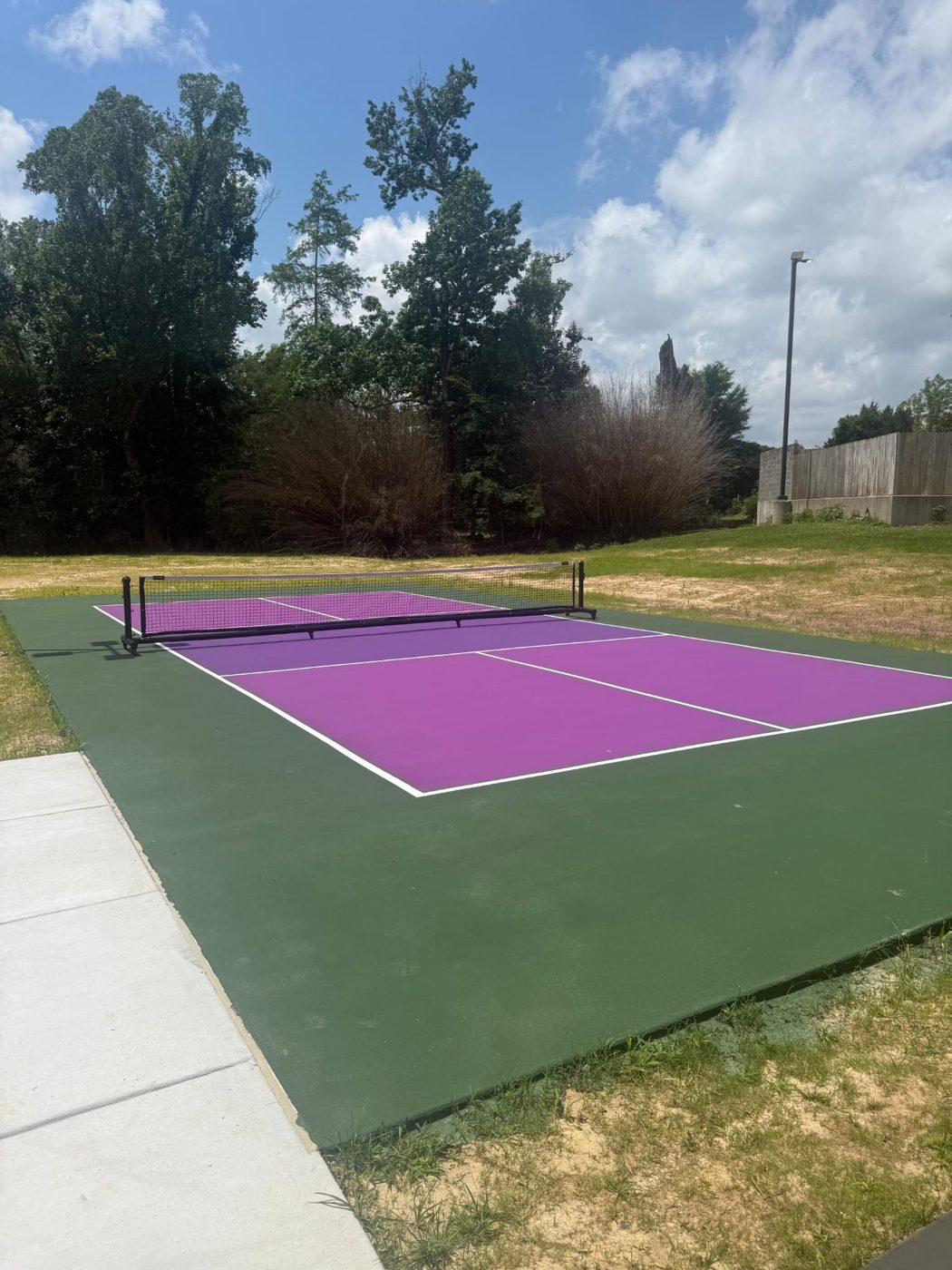
Court work is its own trade inside the outdoor book. The playing surface wants an even texture underfoot with no slick patches and no gritty ones, because a shoe that catches unevenly is how ankles turn. We coat the play zone and the surround in two tones so the boundary reads instantly from the baseline, then lay lines in a masked, pigmented pass rather than taping a stripe onto a cured floor where it can peel at the edge.
Line layout gets snapped and measured before any color goes down, and the dimensions come from the sport you actually play out there, not a guess at the slab. Get that wrong and the floor is permanent proof.
Reading the Slab Before Anybody Quotes It
Connor turns down some exterior slabs, and it is worth saying why plainly. An outdoor pour has no roof over it and often no vapor barrier under it, so ground water rises through the concrete and pushes at the underside of any film you put on top. If a patio sits low, if the yard grades toward it instead of away, if downspouts empty within a few feet of the edge, that slab is wet more hours of the year than it is dry. Coating it without dealing with the water first buys you blisters. So the walk starts with drainage, and if the drainage answer is a French drain or a regraded splash zone, we say so before there is a number on paper.
After water comes the concrete itself. We read moisture instead of trusting the pour date, the same discipline we apply to new construction slabs across Zachary. Then it is cracks: a hairline that has not moved in years gets chased and filled, while a crack with a lip on one side is telling you the two halves are still moving, and a film stretched over that will telegraph it inside a year. Old sealers get ground off entirely, because a coating bonds to profiled concrete and to nothing else. Slabs that fail this read get a straight answer and a different plan, not a polite quote we both regret.
Traction You Can Actually Specify
Every outdoor surface here gets texture, and the amount is a decision rather than a default. Broadcast aggregate goes into the wet coat and the topcoat locks it in, which puts a mechanical grip in the film itself instead of relying on a slippery gloss to somehow behave when it rains. What changes is the grade. A pool surround where children run barefoot wants a fine, rounded profile with plenty of traction and no bite, so wet feet find purchase without anybody losing skin on a knee.
A carport or a service walk takes a coarser grade, since shoes and tires want more tooth and nobody is lying down on it. Court surfaces sit in between, tuned for a pivoting athletic shoe. Covered porches often want the least texture of all, because they see the least standing water and the most bare feet and mop heads. We bring samples so you feel the grades against your own hand before choosing, the same way we bring color samples to a driveway. This part is not upsell, it is the difference between a surface that is safe soaked and one that is a hazard the first afternoon it rains.
Color that survives the exposure
Pigment choice matters more outdoors than in. Deep saturated tones absorb heat, which raises surface temperature under bare feet and speeds the daily expansion cycle, so on unshaded pool decks we steer toward lighter bodies and save the strong color for court zones and accent bands where the visual job is worth the extra degrees.
UV-stable pigment packages hold their value under exposure, and a topcoat refresh years down the road restores the sheen without touching the base build. The color underneath is still the color you picked.
Scheduling Around Gulf South Weather
The hardest part of exterior work in Zachary is not the coating. It is the sky. Summer here produces a convective thunderstorm most afternoons, and a shower that arrives while a coat is still open leaves craters in the film that no amount of buffing repairs. So outdoor crews start at first light and work the cool half of the day, front-loading the passes that must stay dry into the morning window while the radar is empty.
Dew point is the other number that governs the calendar, and it is the one most people have never had to think about. When the slab’s temperature drops to within about five degrees of the dew point, moisture condenses on the surface as an invisible film, and any coating going down over that film loses adhesion or hazes. In a humid Louisiana morning that condition can hold until mid-morning, and it can return in the evening well before dark. We take slab temperature and check the dew point on site rather than guessing from the forecast. If the numbers say wait two hours, we wait two hours, and if a system is stacking up for the afternoon we move the job rather than gamble a whole patio on it. Fall and spring give the widest windows, which is why the outdoor calendar fills first in those seasons.
Where This System Goes in Zachary
- Back patios and screened porches. The most-used outdoor room in a Zachary house, finished so it stops reading as leftover slab.
- Pool decks and surrounds. Fine-grade texture for wet bare feet, with chemical resistance for splash-out.
- Carports and side entries. A cleanable surface that shrugs off tires, dropped tools, and tracked-in yard grit.
- Sport courts. Two-tone zones, snapped line work, and an even athletic texture edge to edge.
- Walkways and exterior steps. The transitions where a wet slip is most likely and grip earns its keep.
Zachary sits at the north end of East Baton Rouge Parish, a short run up Highway 61 from our shop, so a walk here fits into a regular route rather than becoming its own trip. The subdivisions built out around the school district over the past decade poured a lot of back patios, and the older houses near the original town core have slabs with more history in them. Both get the same read. Connor or a senior installer walks the site, checks the water, tests the concrete, and puts the whole scope in writing. See finished exterior work in our gallery, or call (225) 456-9224 and we will get on the calendar.
Other Zachary floor work runs through the same crew and the same standards: flake epoxy for garages and utility rooms, garage coatings built for daily vehicle traffic, industrial coatings for shops and warehouse space, polyaspartic coatings for one-day turnarounds, and this outdoor coatings page for everything past the back door.
Outdoor Coating Questions from Zachary Homeowners
Will the color stay true through a full Zachary summer?
Yes, because the topcoat is aliphatic rather than aromatic epoxy. UV has nothing to break down in that molecule, so the finish keeps its shade instead of drifting yellow and chalking. That single chemistry difference is the reason we never run an indoor epoxy out onto an exposed patio.
How slick does a coated pool surround get when it is wet?
It should not get slick at all. Aggregate broadcast into the wet coat and locked under the topcoat gives mechanical grip that works soaked. Pool decks take a fine, rounded grade so bare feet get traction without abrasion, and you can feel the sample before we settle on it.
My patio holds water after a hard rain. Can it still be coated?
Possibly, once the water has somewhere to go. Standing water and a slab that stays saturated will push a film loose from underneath. If grading or a downspout is feeding the problem, that gets fixed first. Connor calls that on the walk rather than after.
How do afternoon storms affect the install schedule?
They set it. Crews start early and get the passes that must stay dry finished in the morning, before the daily convective cells build. If radar shows a system stacking up we shift the day instead of racing it. A shower on an open coat ruins the film permanently.
What does dew point have to do with my patio?
Everything, on a humid morning. When slab temperature falls within a few degrees of the dew point, invisible condensation forms and any coating applied over it loses adhesion. We measure slab temperature on site and wait out the window rather than trusting a phone forecast.
Can you line a backyard court for a specific sport?
Yes. Dimensions get measured and snapped before color, then lines go down as a masked pigmented pass so they live inside the system instead of sitting on top of it. Play zone and surround are coated in two tones so the boundary reads clearly at speed.
Put a Real Finish on the Back of the House
We cover Zachary and the rest of East Baton Rouge Parish for exterior coatings, and the walk costs nothing. Connor or a senior installer reads the drainage, tests the slab, matches the texture grade to how the surface actually gets used, and hands you a written scope with a number that holds. Send us the details through our contact page or call and we will find a dry window.
Call (225) 456-9224 Free Price