Flake Epoxy Flooring
for Shenandoah Garages
Chip-broadcast floors for the garages and shop buildings off Jones Creek and Coursey, where slabs poured from the 1970s onward are dusting and shedding somebody else’s paint. We grind to clean concrete, take the moisture reading, broadcast the blend you picked from samples on your own slab, and lock it under a polyaspartic topcoat. Tires go back on at 48 hours, and the crew that quotes the floor is the crew that lays it.
Dozens of Blends, One Build Under Every One
Flake is the decorative chip-broadcast system in the Signature book, and it comes in dozens of color blends. From one blend to the next, the look changes. The build underneath stays put: a diamond-ground slab, a primer chosen off the moisture reading, a pigmented base coat, vinyl chips thrown by hand into the wet resin, a scrape and vacuum once it sets, and a clear polyaspartic over everything.
Most Shenandoah garages we walk need every layer of that build to earn its keep. These are established slabs. They have carried cars for decades, picked up stains nobody remembers making, and in plenty of houses they have been painted once or twice by past owners. That paint has to come off completely. A chip system laid over old paint can only hold as well as the paint holds the concrete, and that grip already gave out, which is why it is peeling by the door.
Slabs from this era usually pre-date vapor barriers, so the moisture number comes back higher than owners expect for inland ground. When it does, the floor gets built on a vapor-tolerant primer, and the chips go on top of that. Skipping the test to save an hour is how a garage ends up redone.
Full Broadcast on the Big Garages and Shop Buildings
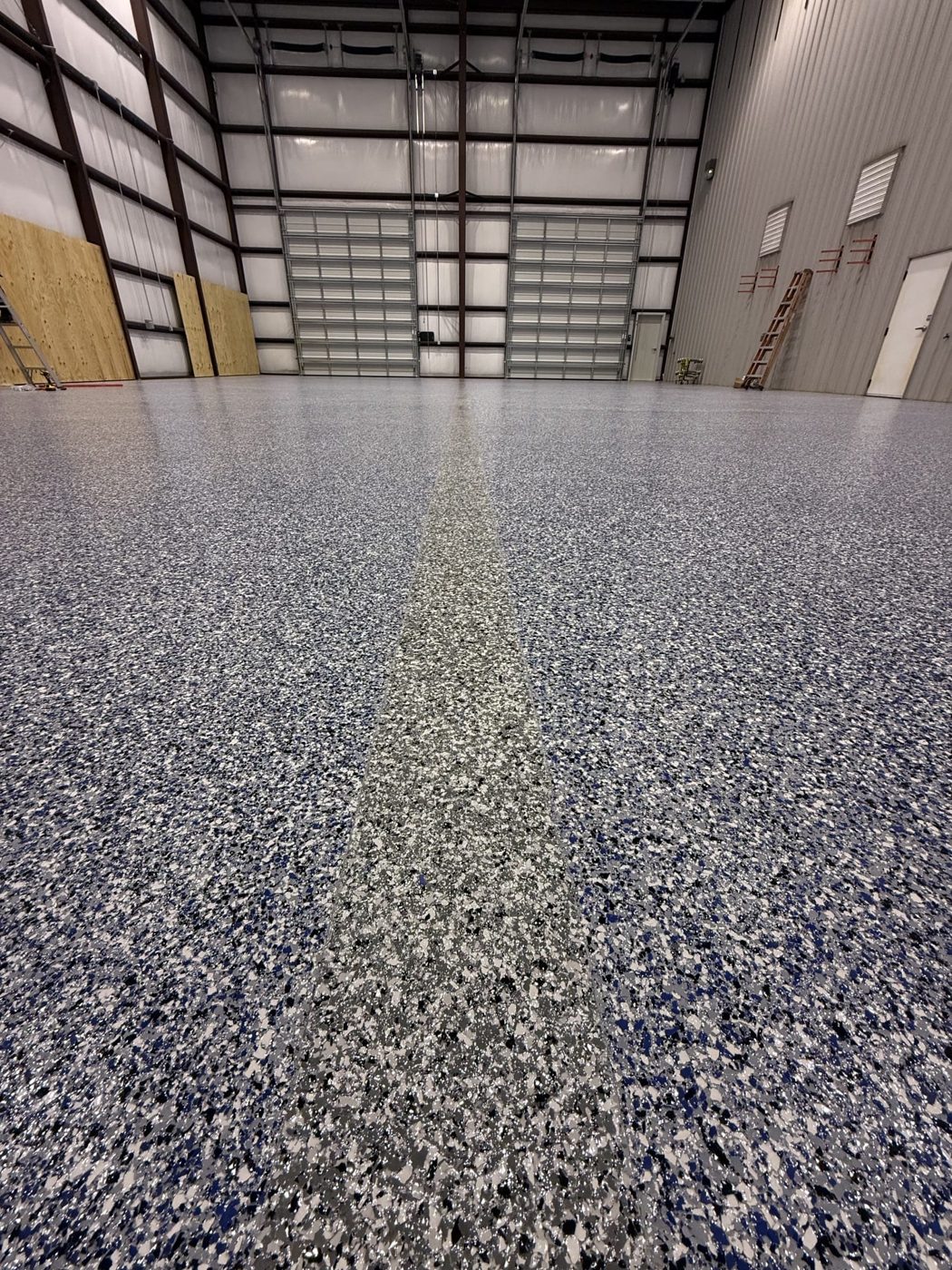
A full broadcast means we keep throwing chips until the base coat disappears. None of the base color shows through, and the finished field has an even, dense texture wall to wall. On a large older garage or a backyard shop building, that is usually what we recommend. Big open slabs show inconsistency, and a partial broadcast across that much concrete can look patchy in the low light coming through a roll-up door.
Chip size is the other lever. Larger flakes read bold from across a big room and do more to disguise texture in an older slab. Smaller flakes give a finer, busier grain that holds up when you are kneeling next to it. In a shop where you stand back from the floor most of the day, bigger chips tend to suit the scale. In a two-car garage that opens into the kitchen, a smaller chip often feels more at home.
A band in a second blend is possible too, like the darker stripe down the middle of this shop. It can mark a work lane or a parking line, and it gets laid out before the broadcast starts.
The Case for Mid Gray
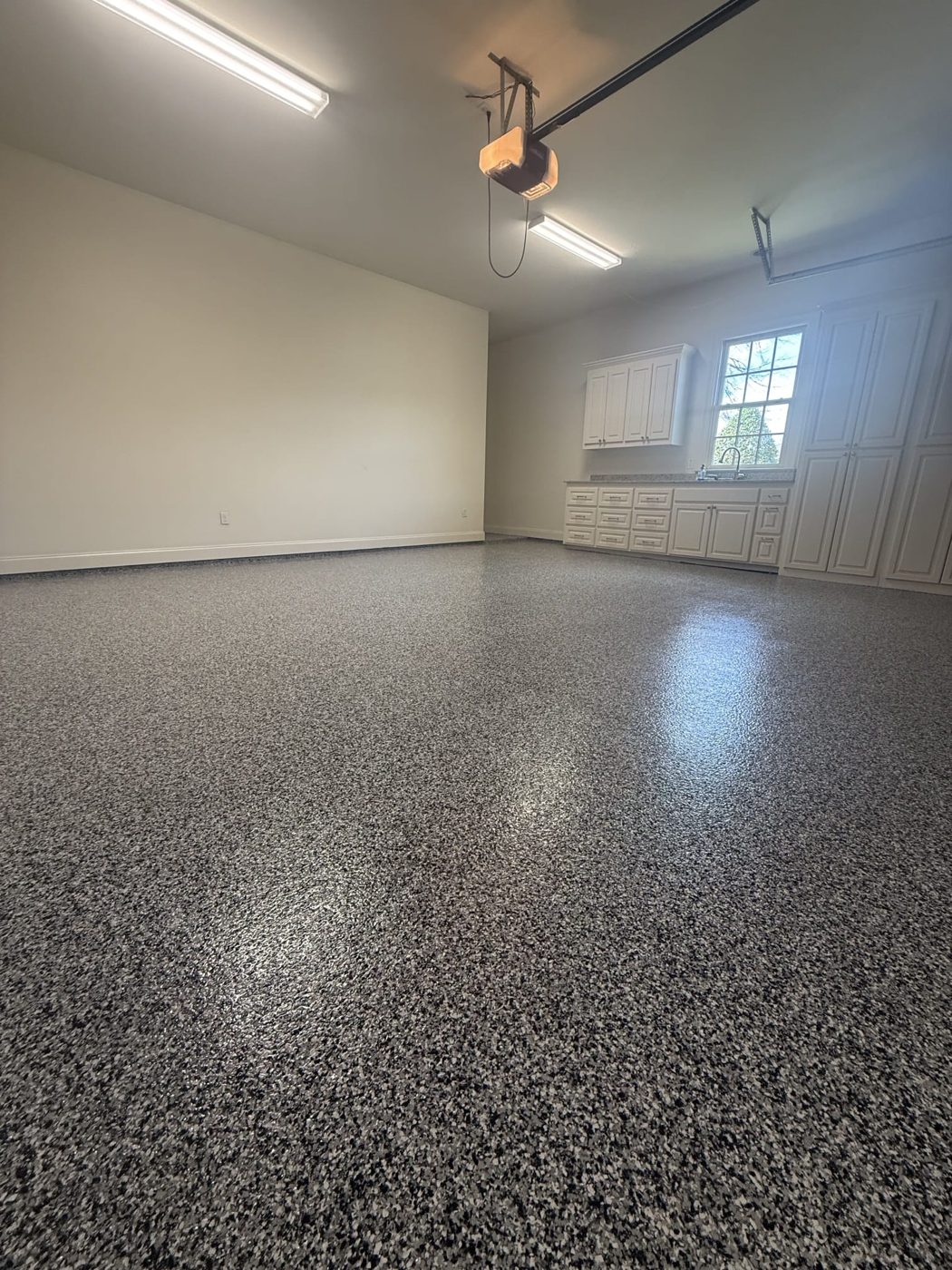
Bright blends catch the eye first on a sample board. A mid gray deserves a second look, and the reason is upkeep. A garage floor collects two kinds of mess: light dust blowing in through the door and dark marks from tires and shoes. A pale blend shows the tire marks. A very dark blend shows every pass of dust. A mid gray with black and white chips sits between the two and hides both until you get around to the broom.
The upkeep after a recoat is short anyway. A push broom and an occasional damp mop cover it. Oil wipes up whole, tires leave no marks on the polyaspartic, and the concrete dust that used to settle on the shelves stops showing up. A forgiving blend makes the days between sweeps easier to ignore.
Plenty of owners still go warmer with tan or brown mixes, or pick a blend with a color chip that ties to the house. Whatever you land on, you choose it standing on your own slab with the door open, because a blend reads differently in every garage’s light.
Carrying the Chips Up the Stem Wall
Lots of garages have a low concrete stem wall along the sides and back, the ledge where the slab meets the framed wall. That ledge takes nearly as much punishment as the floor: mop water, grit from the leaf blower, and the bumper of a car pulled in a foot too far. Leaving it bare puts raw concrete right beside a finished floor, and it is the first thing your eye catches when the door goes up.
So we run the flake up it. The stem wall gets the same grind, the same base coat and the same broadcast, and the chips wrap from floor to ledge in one continuous finish. Where there is no stem wall, a cove base does a similar job, curving the floor up into the wall so water and dirt have no square corner to collect in and the edge is easy to mop.
Height and length change the scope, so both get measured at the walk and written into the quote as their own line. You will know before day one whether the ledge is included and what it takes to do it right.
Two Flake Quotes, Read Line by Line
Neighbors who collect two or three quotes for the same garage often find totals far apart. The gap nearly always sits in the prep. Grinding old paint down to clean concrete, filling cracks with rigid epoxy and testing the slab for moisture all take time and material, and they are the steps that make a floor permanent. A quote that etches the surface and rolls a coating over it skips all three. Ours reads longer on paper for that reason. On any flake quote you get, look for these lines:
- A full diamond grind, with old paint and sealer removed.
- A moisture reading, plus the primer that reading calls for.
- Crack repair, with a note on hairlines versus wider cracks.
- Chip coverage, full or partial, and the chip size.
- The topcoat, and when tires can go back on.
If a line is missing, ask about it. With us, expect confirmed windows, contained grinding and a garage handed back swept each evening. See finished chip floors in our gallery, read the full system on the flake epoxy page, or send your garage details through our contact page.
Other Shenandoah floor systems
- Garage coatings for daily-parked two-car garages.
- Metallic epoxy poured for living spaces and game rooms.
- Anti-slip coatings with gritted topcoats for shops and home gyms.
- Epoxy countertops for kitchens, wet bars and workshop benches.
What Shenandoah Owners Ask About Chip Floors
When can I park on the new floor?
With a polyaspartic topcoat, tires go back on at 48 hours. Plan on two to three days of driveway parking in total, counting grind day. Foot traffic comes back sooner, and the written timeline you get with the price shows each day of the job so nothing is left to guesswork.
Does chip size matter on a big slab?
Yes. Chip size sets the scale of the pattern. Larger chips read bold and busy across a wide garage or shop building, while smaller chips blend into a finer, calmer texture from a few steps back. We lay both sizes on your slab at the walk so you can judge them at real distance.
Can a flake floor carry a stripe or a second blend?
It can. A darker blend can run as a stripe down a shop floor or mark a walkway, broadcast in the same pass as the main color so the two sit in one layer. Where a second blend goes and how wide it runs gets drawn into the scope before install day.
Should I get a full broadcast or a partial one?
On most older garages and shop buildings we recommend full broadcast, where chips cover the base coat completely. It reads even across a large slab and hides more. A partial broadcast lets base color show between the chips. Samples of both go down on your slab at the walk.
Can the flake run up the stem wall?
Yes. The ledge gets the same grind, base coat and broadcast as the floor, so the finish wraps up in one piece. Where there is no stem wall, a cove base curves the floor into the wall instead. Either way, height and length are measured and priced at the walk.
What does the polyaspartic topcoat do over the chips?
It locks the chips down and takes the wear. The topcoat is what tires, dropped tools and daily sweeping actually touch, and it is UV stable, so a garage with the door open much of the day keeps its color. It is also why tires can go back on at 48 hours.
A Short Run East From Baton Rouge
Shenandoah is one of the big established neighborhoods east of Baton Rouge proper, and it sits inside our daily metro routes. That keeps site walks quick and puts a truck on a punch-list item instead of a phone call. Connor or a senior installer walks every slab before quoting, and one crew owns the job from grinder to topcoat. Reach us through our contact page or call (225) 456-9224.
Samples on Your Slab, the Price in Writing
Old paint ground off, moisture tested, your blend broadcast from the floor up the stem wall, and tires back on at 48 hours.
Call the Installer Free Price