Polyaspartic Coatings
in Houma
One-day install, UV-stable, roughly four times stronger than standard epoxy. Polyaspartic floor systems for Houma garages, restaurant kitchens, retail floors, and shops, built to survive Gulf humidity and coastal sun. One crew, written warranty, no subcontracted prep.
Why Polyaspartic Makes Sense in Houma
Polyaspartic is an aliphatic polyurea coating that cures in four to six hours, which is the feature Houma customers notice first. A garage or a restaurant kitchen can go from prepped bare slab to a floor you can walk on the same day, and back in service by the next. But the reason we specify it so often here is not just speed. Polyaspartic is UV stable, so it does not yellow or chalk the way standard epoxy does under the strong coastal sun that hits garage doorways, carport edges, and any surface with daylight exposure. It cures harder than epoxy and resists the salt, chemicals, and constant moisture that come with living and working near the bayous and the Gulf.
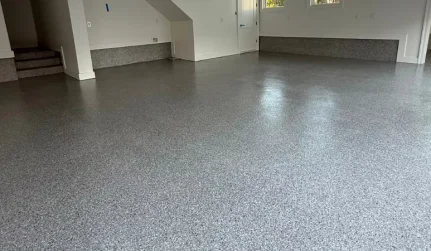
The system is a single-coat polyaspartic base, an optional flake or quartz broadcast for color and texture, and a polyaspartic topcoat. On a Houma slab the layer that makes or breaks the install is still the prep beneath it. Coastal slabs carry a heavy moisture load, so we test every slab and mitigate moisture before the base coat goes down. Every project starts with a walkthrough by Connor or a senior installer, a written scope and fixed quote, and a schedule we hold to.
Where Polyaspartic Coatings Work in Houma
- Residential garages. Fast turnaround, UV stability at the open garage door, and a hard surface that shrugs off tire marks and dropped tools.
- Restaurant kitchens. Seamless, chemical-resistant, and fast to install during a short closure so the kitchen is back on line quickly.
- Retail and showroom floors. A durable, bright, easy-clean surface that carries foot traffic and cart wheels without dulling.
- Basements and warehouse walkways. A tough, moisture-aware finish for the utility and traffic areas that see the hardest wear.
How a Signature Polyaspartic Install Runs in Houma
Four steps, no subcontractors, no surprise change orders. Step one is the walkthrough and scope, where we evaluate slab condition, moisture, existing coatings, drainage, and the use case, and you leave with a written scope and a fixed quote. Step two is prep: diamond grinding or shot blasting to profile, crack chase and fill, joint repair, and full moisture mitigation when the Houma slab calls for it, because most coating failures trace straight back to prep. Step three is the install, done by Signature employees on a fixed schedule, often start to walkable finish in a single day. Step four is the topcoat and final walkthrough, sealed, inspected, signed off, warranty in hand. See the full system on our polyaspartic coatings page and finished floors in our gallery. Call (225) 456-9224 or contact us.
The One-Day Timeline That Suits Houma Businesses
For a restaurant, a retail floor, or a shop, downtime is money, and that is where the polyaspartic timeline changes the math. A standard epoxy floor can tie up a space for the better part of a week between coats and cure, which for a Houma kitchen or storefront means days of lost business. Polyaspartic collapses that. On a floor with a sound slab, we can grind and prep, lay the base, broadcast color if specified, and topcoat all in a single working day, with the floor walkable that evening and back in full service the next. For a restaurant that closes one day a week, the entire floor can turn over during that normal closure without touching the schedule. That is the reason we specify polyaspartic so often for Houma’s commercial customers even when a slower system would technically do the job.
The fast cure is a chemistry feature, not a shortcut. Polyaspartic reaches its handling and service strength in hours rather than days, but the prep underneath it is exactly as thorough as any other Signature install: full grind, crack and joint repair, and moisture mitigation on the coastal slabs that need it. Speed never comes out of the prep, because prep is what makes the floor last. If your operation cannot afford a long closure, tell us the window you have and we will build the schedule around it. Reach Connor at (225) 456-9224 or through our contact page, and see finished commercial floors in our gallery.
Polyaspartic vs Epoxy for a Houma Floor
Homeowners and facility managers in Houma often ask whether they should choose polyaspartic or epoxy, and the honest answer is that the two are not really rivals. They are different tools, and the best floors here frequently use both. Epoxy is a workhorse base with excellent adhesion into concrete and strong chemical resistance, but standard epoxy yellows under UV and cures slowly. Polyaspartic cures in hours, stays clear under sun, and finishes harder, but it is often used as a topcoat over an epoxy base rather than as the entire system. For a Houma garage with a sun-exposed door, a common and durable build is an epoxy base coat for adhesion, a flake broadcast for looks and grip, and a polyaspartic topcoat for UV stability and wear. You get the strengths of each layer instead of forcing one product to do everything.
Where polyaspartic stands on its own is speed-critical commercial work and any surface that needs true UV stability. A restaurant that cannot close for a week, a retail floor that has to reopen on Monday, or a bright entry that catches daylight all point toward polyaspartic. What never changes, whichever build we recommend, is the prep beneath it. In Houma’s coastal conditions the slab moisture and profile decide whether the floor lasts, so every polyaspartic and epoxy floor we install gets the same testing, grinding, and mitigation. We will tell you honestly which system, or which combination, fits your space and your schedule rather than pushing whichever is easiest for us. Call (225) 456-9224 or reach us through our contact page to talk it through.
Polyaspartic in Houma’s Oilfield and Marine Shops
The one-day timeline and the UV stability are what residential and restaurant customers ask about, but polyaspartic earns its place in Houma’s working shops for a different reason: it goes down fast in buildings that cannot afford to sit idle. The oilfield fabrication shops and marine service yards off the Houma Navigation Canal run to the tide and to delivery schedules, and a floor system that ties up a bay for most of a week is a real cost in lost production. A polyaspartic build, or a polyaspartic topcoat over an epoxy base, lets us return a shop bay or a parts room to service in a fraction of that time while still delivering the hard, chemical-resistant surface those spaces need. On a floor that sees hydraulic fluid, cutting oils, and forklift traffic, the polyaspartic topcoat adds abrasion resistance and a seamless surface that wipes clean, and its fast cure means the crew can lay it during a short shutdown window instead of a full shop closure.
The coastal moisture load that governs every Houma slab governs these shop floors too, and the low-lying buildings along the bayou hold more of it than an inland warehouse ever would. That is why a polyaspartic install in an oilfield or marine shop still starts with a moisture reading and, where the slab calls for it, a vapor-mitigation primer beneath the system. Skipping that step in a canal-side building is the surest way to see a floor lift within a season. Hurricane season adds the same scheduling discipline we bring to any coastal install: we read the slab on the day we coat and hold the window when the concrete is still releasing storm moisture. Reach Connor at (225) 456-9224 or through our contact page, and see finished commercial floors in our gallery.
Polyaspartic Coatings in Houma FAQ
Can a polyaspartic floor really be installed in one day in Houma?
Yes, for most residential garages. Polyaspartic cures in four to six hours, so a prepped garage can go base coat, broadcast, and topcoat in a single day and be walkable that evening. Slab condition and moisture mitigation can add a day of prep. We confirm the timeline in your written quote. Call (225) 456-9224 to schedule a walkthrough.
Is polyaspartic worth it over epoxy in Houma’s climate?
In most cases here, yes. Polyaspartic is UV stable, so it does not yellow under the coastal sun the way epoxy does at open garage doors and carports. It cures harder and resists salt, moisture, and chemicals well. We often run an epoxy base with a polyaspartic topcoat to combine strong adhesion with UV performance.
Will polyaspartic hold up to Houma humidity and moisture?
When the slab is tested and moisture-mitigated first, yes. Humidity affects the concrete substrate more than the cured coating, which is why prep is the deciding factor. We test slab moisture on every Houma job and specify the correct primer before the base coat goes down.
How long does a polyaspartic floor last in Houma?
Twenty years or more with full UV stability, no yellowing, and no chalking under sunlight exposure. As with any coating, service life depends heavily on how well the slab was prepped and moisture-mitigated at installation.
Do you handle floor prep yourselves for Houma polyaspartic jobs?
Yes. Every quote includes diamond grinding, crack chase and fill, joint repair, and moisture mitigation as needed. We own the equipment and never subcontract prep, because in Houma’s coastal conditions the prep is what determines whether the floor holds.
Polyaspartic Coatings in Houma
One-day, UV-stable floor systems built for coastal conditions. Proper prep, no shortcuts.
Call (225) 456-9224 Free Price