Flake Epoxy Flooring
in Zachary
Chip-broadcast garage and shop floors for the newer homes filling the north end of East Baton Rouge Parish. Diamond-ground slab, tested moisture, and a polyaspartic topcoat rated for Gulf-South summers. Signature employees do the prep, and the number you approve is the number you pay.
Why Chip Floors Fit Zachary’s Newer Garages
A flake floor is built in layers. We roll a pigmented epoxy base, hand-broadcast colored vinyl chips into it while the resin is still open, scrape the loose material back the next morning, and lock everything down under a clear polyaspartic. The finished surface has texture you can feel through a shoe, and in a Zachary garage that texture does most of the work. Attached garages here open straight into laundry rooms and mudrooms, so the floor takes cleat marks, bike tires, wagon wheels, and whatever the driveway hands over. A one-color gloss slab keeps a running record of all of it. A chipped surface breaks up the visual field, so the same dust and scuffing goes unnoticed between sweeps.
The texture pays off underfoot too. Rain drips off a truck bed and pools near the door, and a smooth coating turns slick right where somebody is carrying groceries. The raised chip edges give a shoe something to bite. That combination, forgiving to look at and steady to walk on, is the reason chip systems outsell everything else we install for families in this part of the parish.
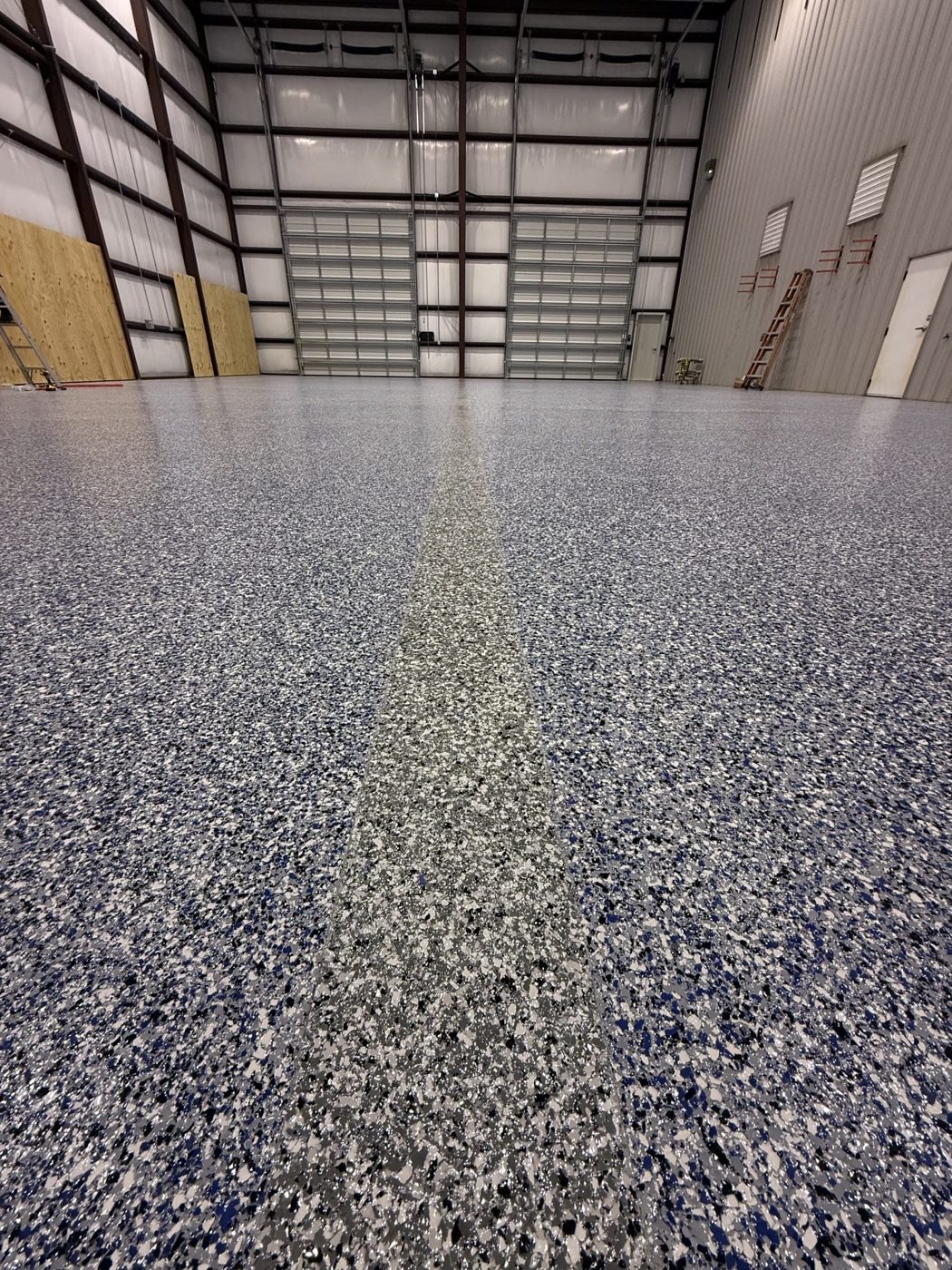
What you are actually buying is four coats of material and a day of grinding. The chips carry the look. The resin under them carries the bond, and the clear coat over them carries the abuse. Skip a step in that stack and the floor tells on you inside two summers.
New Slabs, Vapor, and the Moisture Reading
Zachary’s growth has been steady enough that a large share of our work here lands on concrete poured within the last few years. Fresh concrete looks finished long before it is ready to be sealed. Water keeps migrating up through the slab for weeks after the surface is hard enough to park on, and a coating laid over that water traps it. The result shows up later as blisters, cloudy patches, or a sheet of coating that peels off in one piece. It has nothing to do with the resin brand and everything to do with timing.
So we test rather than count days on a calendar. A moisture reading tells us what the slab is doing right now, and the number drives the specification: a standard primer when the reading is low, a moisture-tolerant primer when it runs higher, and a scheduling conversation when it runs higher still. Louisiana humidity works the same problem from the other direction, because a slab in a closed garage in August can pull moisture out of the air overnight and sit damp at the surface when the crew arrives. We watch dew point against slab temperature and adjust the pour window instead of pushing through it.
Homeowners occasionally hear that as delay. It is the opposite. Waiting a week costs a week. Coating a wet slab costs the whole floor, and there is no way to repair that failure short of grinding the material back off and starting over. Connor or a senior installer takes the reading in person during the walkthrough, and if the answer is wait, you get told why in plain terms before anything is signed.
Hot Tires, Sun, and the Polyaspartic Topcoat
Park a truck on a Louisiana driveway through a July afternoon and the tires come home carrying real heat. Rubber that hot softens slightly, and the plasticizers in it will grab at a coating that has not fully hardened or was never rated for the load. When the tire cools it contracts and lifts a coin-sized patch of coating with it. That is hot-tire pickup, and it is the single most common failure we get called to look at on garage floors somebody else installed.
Two things prevent it: bond from the grind, and a polyaspartic clear that stays hard through the swing between a shaded garage and a sun-loaded driveway apron. It is also stable under ultraviolet light, where straight epoxy yellows near an open overhead door. The transition zone at that door takes the worst of everything anyway, so we carry the coating across the threshold rather than stopping it short, and run a slightly heavier film on the strip where a floor either proves itself or starts to fail.
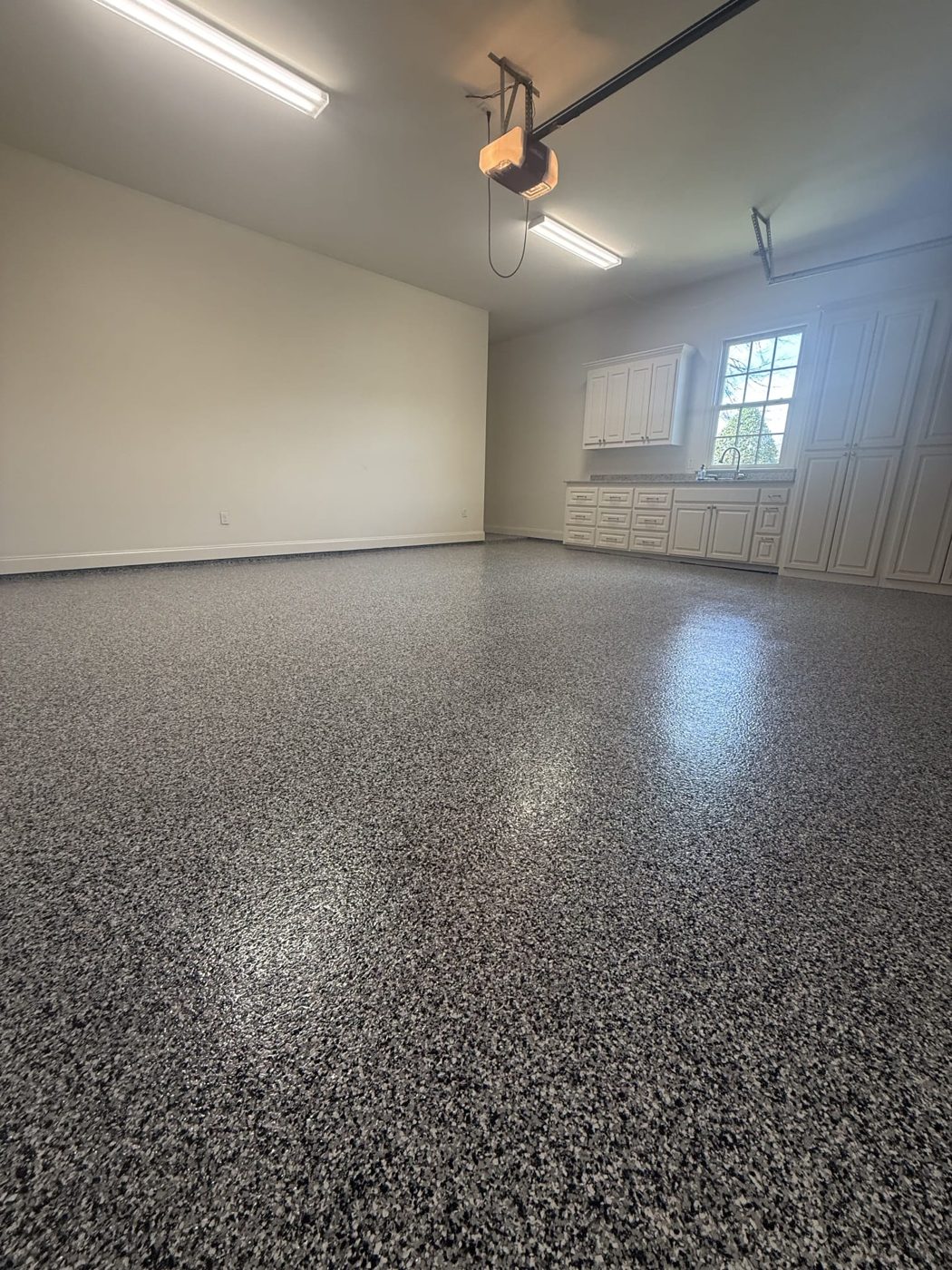
Blend and chip size change the character of a garage more than most people expect. Larger chips read bolder and hide more; smaller chips read tighter and more contemporary. Full coverage buries the base color completely and gives a rich, uniform field. A lighter broadcast lets the base tone breathe through for a softer look.
We bring physical samples to the walk and set them on your slab, because a blend judged under showroom lighting rarely matches how it reads with your overhead door open at four in the afternoon.
Picking a Blend That Still Looks Right in Year Five
Neutrals lead in Zachary, and for good reason. Gray, tan, and charcoal-based mixes with white and black flecks hold up visually against the red clay dust and lawn clippings that come with a yard-heavy neighborhood. Very pale blends show every oil drop. Very dark ones show every speck of pollen in spring. The middle of the range forgives both, which is why most of the samples that come home from our walks live there.
Contrast matters as much as color. A blend with several tones in it disguises debris because your eye is already reading variation. A near-solid blend with one accent chip looks sharp on install day and starts showing its age faster. If the garage doubles as a workshop or a home gym, we usually push toward more contrast. If it is mostly parking and storage, a calmer mix reads cleaner against the house.
The last consideration is the rest of the house. A garage that opens into a finished mudroom benefits from a blend that relates to the flooring on the other side of that door, since you see both at once every time you walk in. Owners who plan to sell within a few years tend to do best with a restrained neutral, because it flatters a wide range of tastes at an open house. We will give you a straight opinion when you ask for one, then build whatever you pick. Browse finished floors in our gallery, read the full system on our flake epoxy page, or call (225) 456-9224.
The Prep Signature Does Before Any Color Goes Down
Grinding is the job. We run diamond tooling across the entire slab until the surface is open and profiled, which strips old sealers, curing compounds, paint, and the polished skin left behind by a power trowel. That skin is why a hardware-store kit peels: the resin never touched concrete, only a sealed film sitting on top of it. Opened concrete drinks the primer and the bond becomes mechanical rather than a hope.
After the grind we chase every crack out to sound material, fill it with a structural repair resin, and treat control joints according to whether they need to stay flexible or get filled solid. Low spots get patched, spalled edges near the door get rebuilt, and anchor bolts or old shelving holes get filled flush. Then the floor is vacuumed to dust-free, because a single pass of a broom leaves enough fines behind to compromise a primer coat.
Only then does material go down: primer keyed to the moisture reading, pigmented base, chip broadcast to the coverage you approved, scrape and vacuum, and the polyaspartic clear. Signature employees run every one of those steps. Nothing here is handed to a subcontractor, which is the reason we can put a written warranty in your hand on the day the crew pulls out. Send your details through our contact page and we will set the walk.
Other floors we install in Zachary
- Flake epoxy, the chip-broadcast system on this page.
- Garage coatings built around daily vehicle traffic.
- Polyaspartic coatings for a one-day, UV-stable finish.
- Industrial coatings for shops and service buildings.
- Outdoor epoxy coatings for patios and exterior slabs.
Flake Epoxy in Zachary FAQ
My house is only a few years old. Is the slab ready for a chip floor?
Probably, but we confirm it with a moisture reading rather than assuming. Newer concrete can still be releasing water at the surface long after it feels dry. The reading takes minutes during the walk and decides which primer goes down, so nothing gets guessed. Call (225) 456-9224 to set that visit.
Will summer heat off my tires damage the finish?
Not on a floor built this way. Hot-tire pickup happens when a coating is poorly bonded or too soft to handle warm rubber. A full diamond grind gives the resin a mechanical grip, and the polyaspartic clear stays hard through the temperature swing between a shaded garage and a sun-baked driveway.
How much of my garage do the chips actually cover?
Your call. A full broadcast buries the base coat entirely for a dense, uniform field. A lighter broadcast leaves some base color visible for a softer look. We set physical samples on your slab so you can judge both under the light your garage really has before anything is ordered.
Can I park on it the same week you finish?
Most residential jobs run two to three days on site, and vehicles go back on after the topcoat has cured for the interval printed in your scope. Foot traffic returns sooner. Slab condition drives the schedule, so your written timeline comes with the price, not after it.
Do you coat the strip by the overhead door?
Yes, and we run a heavier film there. That threshold sees direct sun, hot tires, standing rain, and every bit of grit tracked off the driveway, so stopping the coating short of it puts the weakest edge exactly where the abuse lands. We carry the finish through the transition.
Who is on my property during the install?
Signature employees only. Grinding, crack repair, broadcast, and topcoat all belong to our crew, with no prep handed to an outside contractor. Connor or a senior installer walks the site first and again at the end, and the written warranty goes in your hand the day we leave.
Working the North End of the Parish
Zachary sits at the top of East Baton Rouge Parish, and our crews run up to it from the Baton Rouge shop on their regular routes. That proximity is practical rather than promotional: site walks get scheduled quickly, a punch-list item gets a truck instead of a phone call, and warranty service does not wait on a road trip. Connor or a senior installer walks your slab before any number is written. Reach us through our contact page or call (225) 456-9224.
Chip Floors for Zachary Garages
Tested slab, full diamond grind, the blend you picked, and a polyaspartic clear built for Louisiana summers.
Call the Installer Get a Project Price