Out Friday Morning, Parked Saturday: How the One-Day Floor Really Works
Key Points
- Grind, base, broadcast and clear all fit into one day on a sound slab
- Louisiana heat shortens working time sharply, so crew discipline decides the result
- Aliphatic chemistry keeps the sunlit strip near the door from ambering
- Windowless shops and large closed buildings often do better on epoxy
Ask a Zachary family what they dislike about the idea of a coated garage and the answer is almost never the floor. It is the week. A household that stores two vehicles, a deep freeze, the lawn equipment, and whatever the school season currently demands cannot hand that room over for six days. Polyaspartic exists to solve exactly that problem, and around here it wins most residential jobs on the strength of the schedule alone. But it is a demanding material to install correctly, and it is not the right answer in every building. This is the honest version of both halves.
What One Day Actually Looks Like
The crew arrives early. Grinding runs first, wall to wall, opening the concrete profile and pulling old sealer, paint, or the troweled skin off the surface while vacuum shrouds keep the dust contained. Cracks get chased and filled, spalled corners near the door get rebuilt, and the slab gets vacuumed to genuinely dust free rather than broom clean.
The base coat goes down late morning, and colored chip is hand-broadcast into it while the resin is still open. After the base has set enough to walk, the loose material gets scraped back and vacuumed off, and the clear polyaspartic wear coat goes on top in the afternoon.
By evening the floor is holding foot traffic. You can load shelving back that night. Vehicles come home the following day, once the film has finished building hardness, and that sequencing matters: a car parked too early presses a tire outline into the surface permanently. Park last, always. The compressed schedule means the freezer spends one night in the carport instead of most of a week.

The Clock Inside the Pail
Here is the part no product brochure mentions. Polyaspartic sets on a timer, and heat winds that timer forward hard. A batch that would give a crew a comfortable half hour of working time in mild weather might hand them half that on a humid August afternoon in this parish. Once it begins to thicken it thickens fast, and nothing revives it. Whatever is left in the pail becomes an expensive brick.
So installing this material well is a crew skill rather than a product purchase. Our installers mix small batches instead of large ones, stage every tool and every bag of chip before a pail gets opened, and keep two people on the roller so the wet edge never stalls. On hot days the start time moves earlier rather than the crew fighting the afternoon, and the catalyst ratio gets chosen against the conditions on site that morning rather than a forecast from three days back.
A crew that has not worked a Louisiana summer with this material learns the hard way, and the evidence is permanent: roller stop marks, lap lines where one pass set before the next arrived, texture that changes halfway down the bay. That is why every step stays with Signature employees. Read the full system on our Zachary polyaspartic coatings page.
The Strip Inside the Door Is the Test
Open a garage door here at four in the afternoon in July and sunlight lands squarely on the first several feet of slab. Standard epoxy resents that. Give it a couple of seasons of direct exposure and it ambers, then chalks, and the front of the bay ends up a visibly different shade from the back. Owners see it as a stripe running parallel to the door track, and there is no cleaning it back out.
Polyaspartic resins are built on aliphatic chemistry, which in plain terms means daylight has nothing to break down. The clear stays clear. A blend chosen to relate to the house holds the tone it had on install day instead of drifting warm across the sunlit half of the floor.
That same reasoning extends past the garage. Any slab that catches real daylight is a candidate, which is why carport pads, breezeways between house and garage, porch slabs, and shop entries all get the sun-stable clear rather than a cheaper topcoat that will want redoing. Browse finished floors in our project gallery or call (225) 456-9224.
When Connor Talks You Out of It
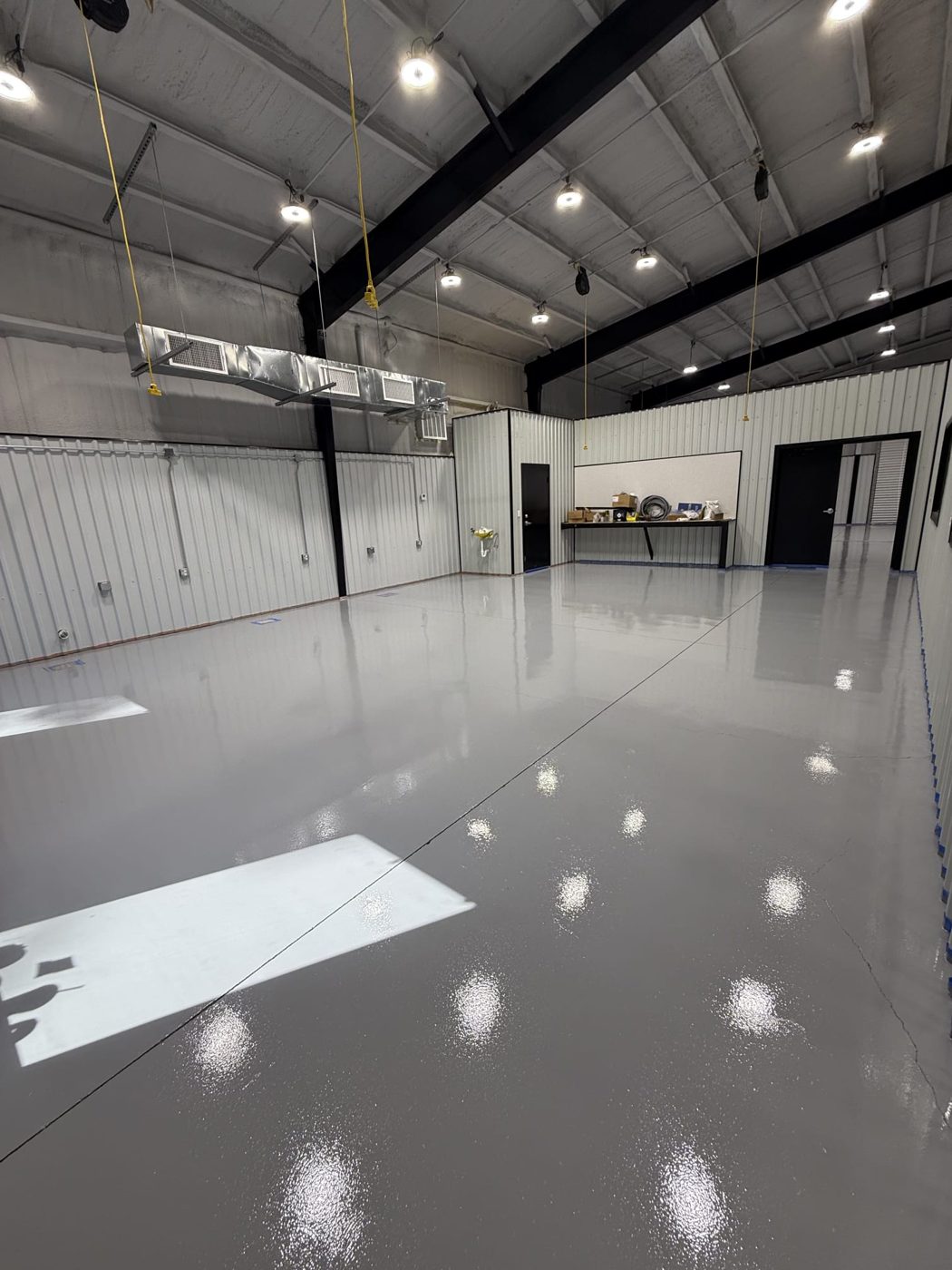
Not every Zachary floor should get this material, and we say so before a number gets written. A shop building with no daylight reaching the concrete gains nothing from a sun-stable clear, and the money is better spent on film thickness where the abuse actually lands. The same goes for an interior storage room, a windowless utility bay, or an outbuilding with the doors shut most of the year.
Big commercial slabs read differently too. When there are several thousand square feet to cover and the building is closed for the work anyway, the fast return buys nothing, and a slower epoxy build gives the crew the working time to keep the entire floor even from one end to the other. Speed is only valuable when somebody is waiting on the room.
One more clarification worth making, because we field it constantly: a flake floor and a polyaspartic floor are not competing options on a quote sheet. Most of the time you are getting both, as separate layers of one system. The base grips the prepared concrete, the chip carries color and texture, and the polyaspartic clear on top faces the sunlight and the traffic. Send your details through our contact page and we will confirm the build after the walk.
One-Day Floor Questions
Does the fast cure make the floor weaker?
No. It finishes harder than standard epoxy and sheds the black scuffing hot tires leave on bare concrete. Dropped sockets bounce off it and bike kickstands do not dig in. The speed comes from the resin chemistry, not from a thinner or cheaper build.
What if the moisture reading comes back high?
Then a mitigation primer goes down first and the job runs a day longer. That is a fair trade against a coating that blisters. Your written scope states the exact return window once the slab has been read, so nothing about the schedule is a surprise on install week.
Should I get this or a plain epoxy floor?
It depends on daylight and downtime. Garages, porches, and anywhere sun reaches the slab want the sun-stable clear. Closed shops and large commercial floors with a real shutdown window often do better on a slower epoxy. Call (225) 456-9224 and describe the space.
Give Up One Day, Not One Week
Tell us the weekend that suits your household and we will read the slab, confirm the build, and set the crew against it.
Call (225) 456-9224 Free Price