Past the Back Door: Coating Patios, Pool Surrounds and Backyard Courts
Key Points
- Exterior work uses aliphatic resin so ultraviolet light has nothing to break down
- Texture grade is specified per surface, from barefoot pool decks to carport pads
- Where water sits and where it drains gets settled before any number is written
- Dew point and afternoon storms set the calendar, so spring and fall fill first
The back of a Zachary house is where the family actually lives half the year. Patios, screened porches, pool surrounds, carport pads, and the backyard sport courts going in across the north end of the parish all sit on concrete that gets treated far worse than anything inside the garage. Exterior slabs have no roof over the sun and often no vapor barrier under them, so the coating on top has to answer to ultraviolet light, thermal swing, standing rain, and bare feet at the same time. Here is how that system differs, and what determines whether your slab is even a candidate.
A Different Molecule, Not a Thicker Coat
Take a product that makes a beautiful garage floor, roll it across an exposed patio, and give it two summers. It ambers. Standard epoxy carries aromatic chemistry in its backbone, ultraviolet light attacks that backbone, and a clean gray or a crisp white drifts toward the color of weak tea while the surface starts to chalk under your palm.
There is no version of that problem you fix with a heavier build or a better installer. The answer is a different resin. Everything we put outdoors is aliphatic, which is a chemistry with nothing in it for ultraviolet to grab, so the finish holds its shade season after season instead of fading.
That chemistry buys a second property worth having down here. Aliphatic polyaspartic stays flexible across a wide temperature range, and an exposed slab in this parish swings hard: a surface hot enough to hurt bare feet at two in the afternoon, then a rapid twenty degree drop when a storm cell arrives and dumps on it. A rigid film cracks over the aggregate under that cycling. A flexible one moves with the concrete and stays bonded.

Where the Water Goes Decides Everything
Connor turns exterior slabs down, and it is worth being plain about why. Ground water rises through concrete that has no barrier beneath it and pushes at the underside of whatever film is on top. If a patio sits low, if the yard grades toward it rather than away, if downspouts empty a few feet from the edge, that slab is wet more hours of the year than it is dry. Coating it without solving the water first buys you blisters and a redo.
So the walk starts with drainage rather than color. If the answer is a French drain or a regraded splash zone, you hear that before there is a number on paper. After water comes the concrete itself, read with a moisture test instead of a pour date. Then cracks: a hairline that has not moved in years gets chased open and filled, while a crack with a lip on one side is telling you the two halves are still working, and a film stretched across it will telegraph inside a year. Old sealers come off entirely, because a coating bonds to profiled concrete and to nothing else. Slabs that fail this read get a straight answer and a different plan. The full scope is on our Zachary outdoor coatings page.
Grip Is a Specification, Not a Hope
Every exterior surface here gets texture, and the grade is chosen rather than defaulted. Aggregate goes into the wet coat and the topcoat locks it in place, which puts mechanical grip inside the film itself instead of trusting a gloss finish to somehow behave when it rains.
What changes surface to surface is how coarse that aggregate runs. A pool surround where children run barefoot wants a fine, rounded profile: plenty of traction, no bite, so wet feet find purchase without anybody losing skin on a knee. A carport pad or a service walk takes something coarser, since shoes and tires want more tooth and nobody is lying down on it. Court surfaces sit between the two, tuned for a pivoting athletic shoe.
Covered porches often want the least texture in the whole book, because they see the least standing water and the most bare feet and mop heads. We bring the grades to the walk so you can feel them against your hand before choosing, the same way color samples come out on a driveway. This is the difference between a surface that is safe soaked and one that becomes a hazard the first afternoon it rains. See finished exterior work in our project gallery.
Dark Colors Cost You Degrees
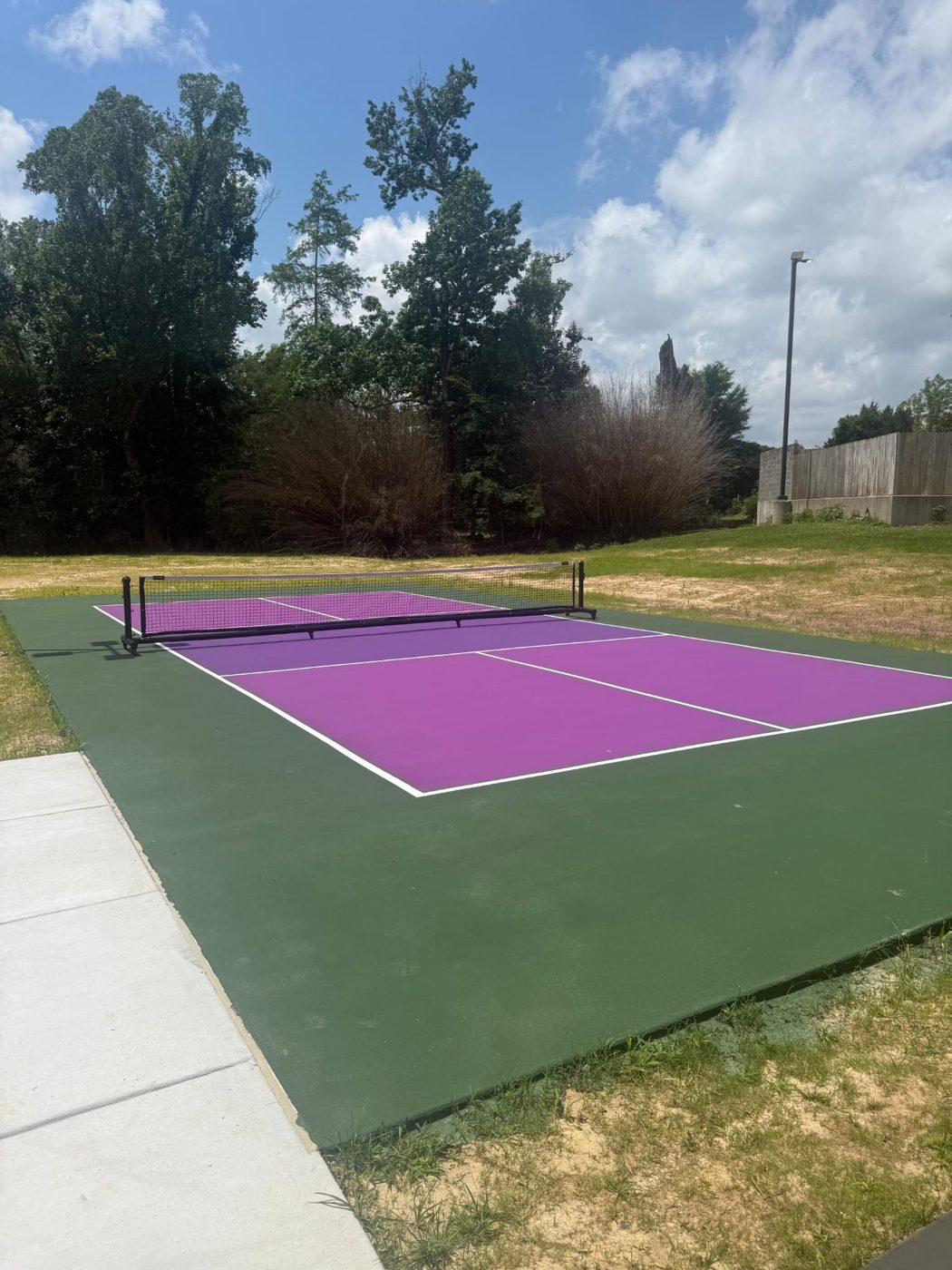
Pigment choice carries more weight outdoors than it does inside. Deep saturated tones absorb heat, which raises the surface temperature under bare feet and speeds up the daily expansion cycle the film has to ride out. On an unshaded pool deck that is a real comfort problem in July, so we steer toward lighter bodies there and save the strong color for court zones and accent bands where the visual payoff justifies the extra degrees.
Court work has its own logic. The play zone and the surround get coated in two tones so the boundary reads instantly from the baseline, and lines go down as a masked pigmented pass rather than tape laid onto a cured floor where the edges peel. Dimensions get measured and snapped before any color moves, taken from the sport you actually play out there. Get that wrong and the slab is permanent proof of it.
Ultraviolet-stable pigment packages hold their value under exposure, and a topcoat refresh years later restores the sheen without disturbing the base build. The color underneath is still the color you picked.
The Sky Sets the Calendar
The hardest part of exterior work here is not the coating. Summer produces a convective thunderstorm most afternoons, and a shower arriving while a coat is still open leaves craters in the film that no amount of buffing repairs. So outdoor crews start at first light and work the cool half of the day, front-loading every pass that must stay dry into the morning while the radar is empty.
Dew point is the other governing number and the one most homeowners have never had to think about. When slab temperature falls within a few degrees of the dew point, moisture condenses on the surface as an invisible film, and anything applied over that film loses adhesion or hazes. On a humid Louisiana morning that condition can hold well past sunrise and return again before dark. We take slab temperature on site and check the dew point there rather than trusting a phone forecast. If the numbers say wait two hours, we wait. If a system is stacking up for the afternoon we move the day instead of gambling a whole patio on it. Spring and fall give the widest windows, which is why the outdoor calendar fills first in those seasons. Send your slab details through our contact page or call (225) 456-9224.
Outdoor Coating Questions
How hot does a coated patio get under bare feet?
Mostly a function of the color you choose. Deep saturated tones absorb noticeably more heat than lighter bodies, so on an unshaded pool surround we push toward the lighter end and reserve strong color for court zones. Shade structures change the math considerably.
Can you coat a screened porch and the patio it opens onto?
Yes, and they usually want different texture grades. A covered porch sees little standing water and plenty of bare feet, so it takes the finest profile. The open patio beyond it gets more tooth. Same system, same day, two specifications.
What is the best season to book exterior work?
Spring and fall, which is exactly why those weeks book out first. The dry windows are longer, the dew point cooperates earlier in the morning, and there is no daily thunderstorm to schedule around. Call (225) 456-9224 ahead of the season you want.
Finish the Back of the House
We read the drainage, test the concrete, match the texture grade to how the surface really gets used, and hand you a written scope that holds.
Call (225) 456-9224 Free Price